Saturday, June 30, 2012

Talking about taking honey and our bee tending intentions

Honey is bee food.  Beekeepers take honey that bees don't need in the Springtime when there is a good nectar flow on and the bees have successfully overwintered.  Beekeepers who take too much honey at the wrong time can starve their bees.  Or find themselves feeding the bees sugar syrup or fondant to make up for the lack of real bee food.

Chuck and I would rather take a little bit of honey, if they have enough to share, and leave the majority to the bees.  We are mostly in it for the pollination, but also with the intention of helping to restore honeybee populations

And we hope that our hands-off way of tending the bees will help to restock the feral bee populations that have been hurt by Colony Collapse Disorder.  It didn't just affect commercial beekeepers and honey farmers.  It has, also, decimate the wild bees.

Honeybees preceded settlers across the continent as soon as they landed.  This was fortunate because so much of the crops that colonists were going to be planting needed those bees. And that hasn't changed. In order to grown a huge amount of food we eat daily, we need honeybees.


Here are some (but not all) of the things they help pollinate:


Alfalfa, allspice, almonds, apples, apricots, avocados, beans (many varieties), beets, blackberries,  blueberries, boysenberries, broccoli, Brussels sprouts, buckwheat, cabbage, cantaloupe, caraway,  cardamom, carrots, cashews, cauliflower,celery, cherries (sweet and sour) chestnuts, clover, coconut, coffee, coriander, cotton, cranberries, cucumbers, currants, eggplants, elderberries, fennel, flax, grapes, guava, kiwi, lemon. lime, loquat, macadamias, mangoes, mustard, nectarine, okra, onions, papaya, peas (many, again) peach, pear, persimmon, plum, pomegranate, rapeseed (aka canola), raspberry, safflower, sesame, soybeans, squash (all sorts), strawberries, sunflowers, tangelos, tangerines, turnips, vetch and watermelon.


And notice that some of the crops listed aren't people food. Alfalfa, clover and vetch are are food for other food.

The other important thing going on with honeybees is that because of how humans have handled them they have been exposed to parasites and diseases that they aren't ready to deal with.  Asian honeybees have developed habits and immunities to varroa mites and the diseases they carry that European honeybees haven't had time to develop.   But because they get moved around the country to pollinate huge monocrops (ie, Florida oranges groves, North Carolina blueberries and California almond orchards that cover an area the size of Rhode Island) they have been exposed to these pathogens fairly regularly.


That has been one of the pieces of the Colony Collapse puzzle.  


Now, some beekeepers are raising queens that produce bees that have "hygienic behavior."  And there are treatments for the mites.  Unfortunately, the treatments create weak bee colonies with resistant mites.  


There is a subculture of beekeepers who are trying to support "survivor bees," bees that have managed to thrive in spite of varroa without help from humans.  These beekeepers let weak colonies die and then restock their hives with swarms caught from healthy hives or feral colonies.  And they don't whine a whole lot if one of their hives swarm away.


So, our hope is to pollinate our garden, get a little honey and to grow healthy bees that will help the Colony Collapse Disorder recovery.



Types of hives

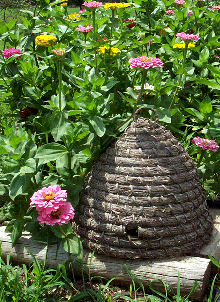
The old fashioned kind of straw hives seen in childrens' books are called skeps and they are simply empty cavities for the bees to do with as they will.   They give bees a place to live, but the whole hive has to be destroyed in order to remove any honey or to check for diseases so they really aren't a good choice if you want to keep that colony


There are, generally, 3 types of beehives used by modern beekeepers. They all have movable parts that allow beekeeper access to the comb so that they can to check on brood and to harvest honey. 

The Langstroth hive was patented in 1852 by an American clergyman named Lorenzo Langstroth and is used by commercial beekeepers because they are easy for humans to manage.  They have frames that guide how the bees make their comb and they frequently have wax foundation to give the bees a start.  This helps beekeepers have more standardized comb that makes honey harvesting easier.  The frames also allow the use of centrifuges (called extractors) to remove the honey from comb that has had the caps sliced off.  After honey extraction, the frames are put back in the hives where the bees get to work cleaning the cells up and refilling them, using less resources to get back up to speed than when other types of hives are used.  The frames are also sturdier than free hanging comb and, therefore, are easier to transport to crops that need pollination or to get a particular type of desirable honey flavor like tupelo, orange blossom or sourwood.

Langs generally have a brood box on the bottom and honey boxes "super"-ed above the brood.    Supers may be deep, medium or small.  Some commercial beekeepers use a queen excluder to keep her from climbing up into the supers and laying brood where the beekeeper is trying to acquire harvestable honey.  If there is brood, the honey can't be used.  But if the nectar flow is good and they have enough space, this isn't a problem.

The "nationals" of the UK are a variation on this theme.

Top Bar and Warré hives are often preferred by "natural" beekeepers.  (There was some argument on the email list of our local beekeepers association, with some holding that any bee tending is unnatural and that the term is an oxymoron.  Whatever.)  Natural beekeepers' purpose is to support the health and well-being of honeybees with as little intervention as the humans can bear to let happen.  Some people have an easier time keeping out of it than others.  Chuck occasionally has to talk me down.  We have determined how we intend to look after the bees and when I get to frettin', he reminds me of what we know and what we have decided is our way of bee support.


Anyway, the point of these other varieties of hive is to try to provide a space that is more similar to the kind of place bees use when they are completely wild.   There are no frames, after all in hollow trees.

Top Bar Hives were developed to be easy to build with simple tools and use without a great deal of fuss.  Kenyans have angled sides and Tanzanians have straight sides. (Ours are Kenyan.)   They provide a long, hollow space  with bars that are spaced to be convenient for bees to build comb down from and also convenient for beekeepers to lift out for honey harvesting.  The only lifting you do with TBHs is lifting the top up to get to the bars.  


The angled sides is because bees don't like to attach to angled sides as much as they do to straight sides.  They attach support wax, but don't build all the way out as they do in straight sided frames or hive boxes.  Tanzanian TBHs sound like a pain in the ass to me but it does have a little more space.


TBHs provide honey for the bees and the beekeeper.  But, because there is no foundation, the bees have to replace to comb from scratch that has been lost when honey was harvested .  So, a lot more bee effort goes into comb building than in frames with foundation..  And they have less time to store honey when they have to spend time building comb first.  And in order to leave them enough to get through dearths (winter or summer dry periods when nothing is blooming), humans need to take less.  


This isn't a good way for commercial honey producers to house their staff.  It is fine if you just want to pollinate your garden and have a little treat for yourself on occasion.


TBHs frequently have windows in the side so beekeepers can look in to see how things are going with out actually removing the bars and disturbing the bees.

Warré, also called a Vertical Top Bar, was developed by Abbé Émile Warré in the middle of the 20th century.  The  Abbé's book on beekeeping, translated by Patricia and David Heaf, can be found HERE.


Warré hives work on the principal that bees draw comb down.  So, the main colony is in the top and the lower space is where honey storage happens.  They use bars rather than frames and have a quilt in the top to absorb moisture and to help insulate against extreme heat and cold.


Abbé Warré believed that bees don't need human help and users of Warrés mess with the bees the least, generally opening the hives only twice a year for a checkup and a honey harvest.  


There are variations on these, long hives, which are sort of beehive duplexes, Perones, which take Warrés a step further and some others.  There are also beekeepers who are using other shapes like hexagons and dodecahedrons to see how those alterations work.  But, as far as I can see, these three are the basic starting place for new beekeepers to decide what hive style best suits their way of tending bees.


Friday, June 29, 2012

Bee food

Before we had bees, these were called weeds in our yard. When I was a kid we called them "shooters", because you could loop the stem around itself and pull the top to the loop and shoot it at someone as it popped off.
We now know that Plantains are a source of bee food in this area, and along with the Clover in the yard, help the girls get through our slow period of the season for other pollen and nectar sources.
So this summer, instead of mowing them down, I am mowing pathways through the yard for the humans.

Monday, June 25, 2012

Our bees are messing with my head

The Rosamund II Rockettes doing their Fan Dance


In the mean time, back at Lucretia II's abode, where all appears serene...


Guess what I found.


Tricking bees

Useful information found at The BioBees forum


Hives can be moved even a relatively short distance if the entrance in the new position is covered with a few branches/leaves. In effect, it is as if a tree has fallen over and the bees living inside it need to re-orientate to a slightly new position.


Sunday, June 24, 2012

Blueberry harvest

This is it for this year.  All from one bush.


We started putting bushes in about 3 years ago.   We found a single variety (Misty) at Lowe's and my friend, Ann, gave us another one for pollination purposes.  (And because she's thoughtful like that.)  These came from the Ann bush (Bright Eyes variety).  It was already bigger than the one from Lowe's when it got here, so, I expect it was older.

We have since added Bright Blue, Climax and Austin varieties to the row long the fence on the left side of the back yard.Whenever we order plants by mail and need to fill out an order, we get a blueberry bush.

The Bright Eyes is about hip height on me.  All the others are more like knee high.  I saw a website a couple of years ago that talked about the ages of bushes relative to when they produce, but I'm thinking that it is more size than age.

Saturday, June 16, 2012

Italians do love oregano


I would like to pinch the oregano so that it is bushier for us to cook with.  But every time I start to do it, there's already a party going on and I don't want to spoil things.

Made me laugh


In part because Chuck and I are both such novices at vegetable gardening and we have started doing it at or after the half century mark.  I have loved messing with flowers ever since I  first put grocery store geraniums in a pot and they didn't die, but had only had some herbs before this experiment began.  

Monday, June 11, 2012

Explaining queen bees

Workers and queens have a really complex arrangement.

Queens are fertilized by several drones in a short period of time.  They may make more than one mating flight, but don't continue mating after that initial frolicsome time when she is young and lithe.

Once she gets situated in a hive, laying eggs, she tends to stay put.

UNLESS, the workers choose to make new queens.  They determine when new queens are produced.  And the old queen doesn't get her feelings hurt, because in spite of the language used in beekeeping, bees are communists.  The good of the many outweighs everything else for a bee.  Even the queen.

Queens have a spermatheca, which is a very specialized organ.  It allows her to lay fertilized or unfertilized eggs  An odd part of that is that the unfertilized eggs produce males/drones.

Workers determine the size of the cells to build in a comb.  They make larger cells if they think they need to produce more drones because, apparently, boy bees need bigger rooms.  (They also take longer to develop.) So the queen knows by the size of the cell she is laying in whether to fertilize that egg or not.

All hatched eggs get royal jelly, produced by a gland in the hypopharynx of the workers, for a day.  Larvae that are going to be queens get all royal jelly all the time.  Drones and workers get switched to honey and pollen after that first day.  All that royal jelly causes the queens' ovaries to develop into functional organs.

If the workers have decided that they need a new queen, they will have her lay fertilized eggs in queen cups and then stuff those larvae with royal jelly until they cap the cups.  And the queen cells are very obvious.  They look like peanuts hanging off the comb.  I think they even have royal jelly snacks in the queen cells with them.

Usually, if they are planning to swarm, they make queen cells on the bottom of the combs.  If they just think the old queen needs replacing, they make supercedure cells up in the main body of the combs.  So, beekeepers will talk about supercedure cells or swarm cells meaning queen cells in the indicated location.

Supercedure happens when the queen is old or weak or generally falling down on the job.

Swarming happens when there are more bees than the hive can hold.  Or they are just so full of life and there is so much good forage that they feel expansive.

When they swarm, the old queen takes a contingent of workers and goes to look for new digs, leaving the old, established hive to her daughter.

The first queen to emerge may rip open her sisters' cells, ending competition.   Or she may wait to see if they actually hatch, then they fight to the death.  I'm not sure if the workers get involved in that decision or not.

About a week later, she makes her mating flight(s), flying about a mile from her hive.  When she is through collecting DNA, she comes back and starts laying eggs according to the plan of the workers.

Drones fly a mile and a half to drone zones where they off their DNA to any queen in search of a little booty, so queens don't mate with their brothers.  Drone Zone would be a great name for a pickup bar.